Clean Energy Transition Drives Down Washington State Emissions
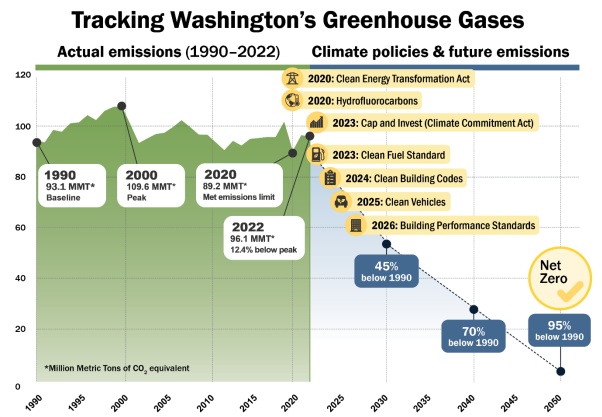
Washington State is continuing to make measurable progress in reducing greenhouse gas emissions, according to the latest interim inventory released by the Washington State Department of Ecology in April 2026. The report, covering the period from 1990 to 2022, shows that emissions declined slightly between 2021 and 2022, reinforcing a longer-term downward trend driven largely by changes in the state’s energy mix.
Total emissions fell from 96.6 million metric tons of carbon dioxide equivalent (MMT CO₂e) in 2021 to 96.1 MMT CO₂e in 2022, a modest reduction of 0.5%. While the annual decrease is relatively small, it reflects structural changes in Washington’s economy and energy systems. Since peaking around 2000, when emissions reached approximately 109 million metric tons, the state has achieved a cumulative reduction of 12.4%, even as population growth and economic expansion have continued at a steady pace.
A key factor behind this trend is the increasing role of clean energy. Growth in wind and solar generation, combined with a strong year for hydropower, contributed to lower emissions in the electricity sector. At the same time, the gradual decline of coal-fired power has played a significant role in reducing overall carbon intensity. However, the report notes that electricity emissions remain sensitive to hydrological conditions. In years with reduced rainfall or snowpack, lower hydropower output can lead to increased reliance on imported electricity or fossil fuel generation, temporarily pushing emissions upward.
Despite progress in the power sector, transportation remains the dominant source of emissions in Washington, accounting for just over 40% of the total in 2022. Emissions from this sector increased slightly as economic activity rebounded following the pandemic, underscoring the continued dependence on petroleum-based fuels. Buildings, including residential, commercial, and industrial facilities, represent the second-largest source. While emissions from this sector have declined compared to historical peaks, there has been a notable shift from petroleum to natural gas as the primary fuel for on-site energy use.
The report also highlights a broader structural shift in the state’s emissions profile. Over time, Washington’s greenhouse gas output has become increasingly decoupled from economic growth. Although emissions dropped sharply in 2020 due to pandemic-related disruptions and rose again in 2021, they stabilized in 2022 at levels significantly below those seen prior to 2019. This suggests that economic expansion is becoming less carbon-intensive, reflecting both policy interventions and technological change.
Other sectors, including agriculture, industrial processes, waste management, and fugitive emissions from fossil fuels, contribute a smaller share of the overall total but remain important components of the state’s emissions inventory. In particular, emissions from industrial refrigerants and methane releases from waste and agriculture continue to present ongoing challenges due to their high global warming potential.
Washington has established legally binding emissions reduction targets under state law, requiring a 45% reduction below 1990 levels by 2030, a 70% reduction by 2040, and a 95% reduction alongside net-zero emissions by 2050. While the state narrowly exceeded its 2020 target, the report suggests that recently implemented policies are likely to accelerate progress in the coming years. These include major regulatory frameworks introduced in 2023, such as the Climate Commitment Act and the Clean Fuel Standard, whose impacts are not yet reflected in the 2022 data.
The timing of the report also highlights a persistent challenge in emissions accounting. Comprehensive inventories rely heavily on federal datasets, which introduce a lag in reporting. To address this, Washington is expanding its use of in-state data sources, enabling more timely tracking of emissions trends. Early indicators from these datasets suggest that emissions may have continued to decline through 2023 and 2024, driven by further growth in renewable energy.
Looking ahead, the Department of Ecology plans to move from biennial to annual reporting, providing more current data to policymakers and stakeholders. This shift is expected to improve transparency and support more responsive climate policy implementation.
Overall, the latest inventory underscores that Washington’s strategy of expanding clean energy while phasing out high-emission sources is yielding tangible results. However, the persistence of emissions in sectors such as transportation indicates that achieving the state’s long-term climate goals will require sustained and accelerated efforts across all areas of the economy.