Japan tests world’s first next-generation hydrogen fuel supply system for power generation
A major step forward in hydrogen-based power generation has been achieved in Japan, where Kawasaki Heavy Industries and Kobe Steel have begun operation of what is described as the world’s first next-generation hydrogen fuel supply system for a power plant using liquefied hydrogen.
The system, developed under a Japan’s New Energy and Industrial Technology Development Organization (NEDO)-supported project, is designed to improve the efficiency of hydrogen-fired electricity generation and support future large-scale deployment of hydrogen gas turbines.
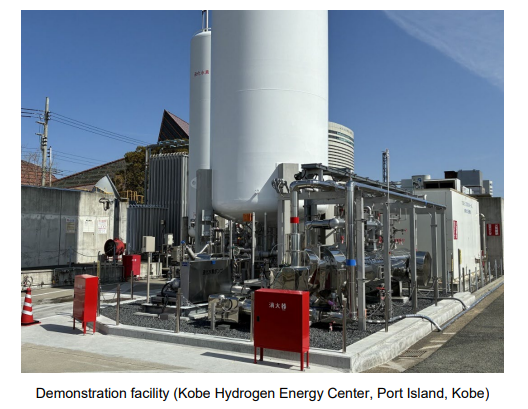
The demonstration is taking place at the Kobe Hydrogen Energy Center in Port Island, Kobe, where hydrogen fuel has already been successfully supplied to a gas turbine generator as part of early-stage testing. The companies plan to expand trials to more advanced turbine configurations and assess long-term operational stability under different environmental conditions.
At the core of the system is a combination of a liquefied hydrogen pump and an Intermediate Fluid Vaporizer (IFV). Liquefied hydrogen is first pressurised using the pump and then vaporised for use as fuel in a gas turbine. Unlike conventional systems that rely on compressing gaseous hydrogen, this approach significantly reduces the energy required for fuel pressurisation.
Hydrogen must typically be compressed to high pressures before it can be used in power generation. This compression process is energy-intensive and represents one of the key efficiency challenges in hydrogen infrastructure. By using liquid hydrogen instead, the new system avoids much of this energy loss, improving overall system efficiency.
Another key feature of the system is the recovery of “cold energy” generated during hydrogen vaporisation. When liquefied hydrogen transitions back into gas form, it absorbs large amounts of heat from its surroundings. In this demonstration, that cooling energy is captured and can potentially be reused for industrial and commercial applications.
Possible uses include cooling gas turbine intake air to improve efficiency, refrigeration and freezing systems, data centre cooling, and air conditioning for industrial facilities. This multi-use energy integration is seen as an important step in improving the economic viability of hydrogen infrastructure.
The demonstration also represents an early step toward integrating hydrogen into combined heat and power systems, where energy is not only generated as electricity but also recovered and reused in different forms. This concept, often referred to as hydrogen cogeneration (CGS), is being explored for industrial zones, urban energy systems, and large-scale manufacturing clusters.
Kawasaki Heavy Industries is responsible for improving fuel supply efficiency through pump and turbine integration, while Kobe Steel has developed the vaporisation system that enables recovery of cold energy. Together, the companies aim to build a scalable model that could eventually support large hydrogen-fuelled power stations.
The project is part of Japan’s broader hydrogen strategy, which positions hydrogen as a key energy carrier in the country’s long-term decarbonisation roadmap. Hydrogen is expected to play a role in sectors that are difficult to electrify, including heavy industry, shipping, and large-scale power generation.
One of the main advantages of hydrogen is that it produces no carbon dioxide when combusted. However, its climate benefit depends heavily on how it is produced. “Green hydrogen,” produced using renewable electricity, is considered the most climate-friendly option, while hydrogen derived from fossil fuels without carbon capture carries a much higher carbon footprint.
Japan, which has limited domestic energy resources, has been actively investing in hydrogen supply chains, including liquefied hydrogen transport, import infrastructure, and power generation technologies. The development of liquefied hydrogen systems is particularly important for enabling long-distance transport and large-scale storage.
The Kobe demonstration is also significant because it focuses on system integration rather than isolated components. Hydrogen energy systems require coordination between production, storage, transport, and end-use applications. Improving efficiency at each stage is essential if hydrogen is to become cost-competitive with conventional fuels.
While still in the demonstration phase, the technology is being positioned as a potential foundation for future hydrogen-fired gas turbine power plants capable of operating at industrial scale. Such systems could eventually be deployed in industrial clusters, port areas, and urban energy networks.
However, challenges remain. Hydrogen infrastructure is still expensive, and large-scale supply chains are not yet fully developed. Efficiency gains from new systems like liquefied hydrogen pumps and heat recovery technologies will be important, but broader deployment will depend on continued reductions in hydrogen production and transport costs.
Despite these challenges, the successful start of operations marks a notable milestone in Japan’s efforts to build a hydrogen-based energy system. If scaled successfully, the technology could contribute to reducing emissions from power generation while expanding the role of hydrogen in future energy systems.